Plain-terms guide
Coinbase USDC Rewards Explained: Rate, Rules and Risks
Coinbase USDC rewards pay a variable rate on USDC held in your Coinbase account. On 10 October 2026, Coinbase's USDC page displayed 3.75% APY, and in the US the rewards are available only to Coinbase One members, a paid subscription with plans from $4.99 a month. The reward is a loyalty payment funded by Coinbase, not bank interest: USDC balances are not deposit accounts, are not FDIC- or SIPC-insured, and the rate can change at any time. A 2025 federal law will bar stablecoin issuers from paying interest once it takes effect, and a stalled Senate bill would extend a similar ban to exchanges.
This guide is for anyone holding dollars in crypto form who wants to know what the rate really pays after the membership fee, where the money comes from, how it is taxed and what could end it. A quick rule of thumb: at 3.75%, the cheapest Coinbase One plan ($4.99 a month, or $59.88 a year billed monthly) is covered only on balances above about $1,597, or about $1,333 on its $49.99 annual price, if rewards are the only reason you subscribe. It is education, not financial advice.
Short answer
USDC rewards are a reasonable-looking rate on a dollar-pegged token, wrapped in conditions that matter. You need a paid membership in the US. You hold a stablecoin with a custodian, not money in a bank. The rate is set by Coinbase, changes by notice, and is under political pressure in Washington. For cash you might need soon, an insured savings account or a Treasury bill does the same job with less to go wrong; for USDC you already keep on Coinbase for other reasons, the reward is a perk with risks attached.
Where the reward comes from
USDC is issued by Circle, which says each token is backed by reserves held separately from its operating funds. Circle's transparency page, read on 10 October 2026 with reserve data as of 8 October, lists those reserves as bank deposits, overnight reverse Treasury repurchase agreements and Treasury bills maturing within three months, partly held in the Circle Reserve Fund, a money market fund. Those assets earn interest, and that interest is the economic engine behind every USDC yield you see.
Coinbase sits next to that engine. Its 2025 annual report shows $1.35 billion of "stablecoin revenue" for the year, and its second-quarter 2026 results showed $292 million for the quarter. USDC is a large business for Coinbase, which explains why it pays holders to keep USDC on the platform. Coinbase's help page describes USDC Rewards as "a loyalty program funded by Coinbase" and says Coinbase "does not use or lend your USDC without your instruction." So the reward is not interest earned by lending your coins; it is Coinbase sharing part of the value of having you hold USDC with it.
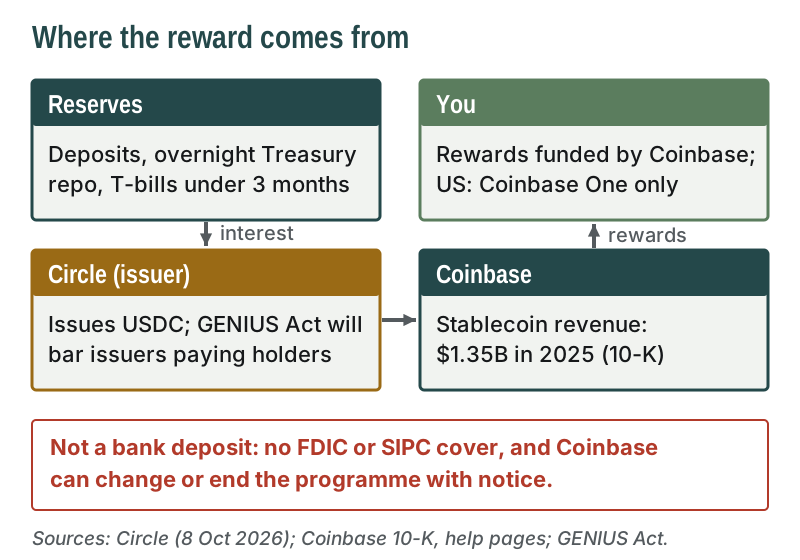
That distinction matters for risk. A lending product can lose your principal if borrowers default; a loyalty reward cannot, because nothing is lent. The risks here sit elsewhere: in the stablecoin itself, in Coinbase as custodian, and in the reward being cut or banned. Our guide to stablecoin yield and depeg risk covers how other stablecoin yields are produced.
Current rate and eligibility (dated)
Coinbase's USDC page displayed 3.75% APY for Coinbase One members on 10 October 2026, with the note that "the rewards rate is subject to change and may vary by region" and that customers see the applicable rate in their accounts. Another Coinbase page, about its borrowing product, displayed a different USDC figure on the same day, so treat any number outside your own account as indicative. Coinbase says rate changes typically take effect on the first day of a calendar month, and some US members may see a limited-time promotional boost.
The eligibility rules come from Coinbase's help page. You must be in an eligible region, be able to trade, and hold at least $1 of USDC; there is no maximum balance. In the United States, the United Kingdom, Australia, Singapore and a few smaller jurisdictions, you must also be a Coinbase One member. Coinbase said in its fourth-quarter 2025 shareholder letter that it had made uncapped USDC rewards a Coinbase One benefit. Rewards accrue daily and are typically paid weekly on Fridays; you can opt out, but you lose any rewards earned and not yet paid.
| Balance | Rewards at 3.75% | Cheapest Coinbase One plan ($4.99/month) | Net if rewards are your only reason to subscribe |
|---|---|---|---|
| $1,000 | $37.50 | $59.88 | -$22.38 |
| $1,597 | $59.88 | $59.88 | about $0 |
| $10,000 | $375.00 | $59.88 | $315.12 |
| $50,000 | $1,875.00 | $59.88 | $1,815.12 |
The table assumes the rate stays where it was displayed, which it may not, and ignores compounding. It uses monthly billing; Coinbase One Basic also costs $49.99 a year paid upfront, which lowers the break-even to about $1,333. Coinbase One has other benefits, so the membership may be worth it to you for other reasons; the point is that small balances do not cover it from rewards alone.
GENIUS Act and the 'rewards vs interest' debate
The GENIUS Act, signed on 18 July 2025 as Public Law 119-27, set the first federal rules for payment stablecoins. Section 4(a)(11) says a permitted or foreign stablecoin issuer may not pay holders "any form of interest or yield" solely for holding, using or retaining the stablecoin. The clause is written about issuers. It does not name exchanges or other third parties, which is the reading under which exchanges such as Coinbase keep paying rewards while Circle itself will not be able to pay holders once the law applies. No regulator has ruled on that reading.
The law takes effect on the earlier of 18 January 2027 or 120 days after regulators issue final rules. As of 9 October 2026 the main rules were still proposals: the OCC proposed its rule on 2 March 2026, Treasury on 18 August 2026 with comments open until 19 October, and the Federal Reserve on 29 September 2026. Whether any final rule reaches exchange rewards is not settled.
The bigger threat is in Congress. The CLARITY Act passed the House 294 to 134 on 17 July 2025. The version reported by the Senate Banking Committee on 1 June 2026 added Section 404, which would bar digital asset service providers and their affiliates from paying US customers interest or yield solely for holding a payment stablecoin, or on a stablecoin balance in a way equivalent to bank-deposit interest, while still allowing rewards tied to genuine activity or transactions. On 15 September 2026 the Senate failed to invoke cloture on the bill, 49 to 50, so it is stalled, not law. If a version like that passed, balance-based rewards of the kind Coinbase pays would have to change.
Risks: depeg, custodial, rate changes
- Depeg. USDC is designed to be redeemable 1:1 for dollars, but a stablecoin's market price can slip below $1 under stress. A reward of a few percent does not offset a few cents of depeg on the principal.
- Custody. Your USDC sits with Coinbase. Coinbase's annual report says customer assets are held under UCC Article 8 so they should not be Coinbase's property in a bankruptcy, but it also acknowledges that courts have not tested this, and customers could be treated as unsecured creditors.
- No insurance. Coinbase's help page says USDC balances "are not considered deposit accounts" and are "not insured by the Federal Deposit Insurance Corporation (FDIC) or the Securities Investor Protection Corporation (SIPC)."
- Rate and programme changes. Coinbase reserves the right to change or discontinue USDC Rewards by reasonable notice, and has already moved them behind a paid membership in several countries.
- Policy risk. The CLARITY Act's Section 404, if revived and enacted, would restrict balance-based rewards.
None of these is a reason to panic about USDC held for trading or payments. Together they are the reason not to treat USDC on an exchange as a savings account. We set out the general hierarchy of options in the safest ways to earn interest on crypto.
USDC rewards vs a high-yield savings account
The fair comparison is with where else a dollar can sit. The FDIC's national average savings rate, in its September 2026 monthly update, was 0.37%, and its national 12-month CD average was 1.73%. High-yield savings accounts pay more than the national average; rates differ by bank. A 13-week Treasury bill yielded 4.16% on a coupon-equivalent basis on 9 October 2026. The USDC reward sits between the bank averages and Treasuries, before the membership fee.
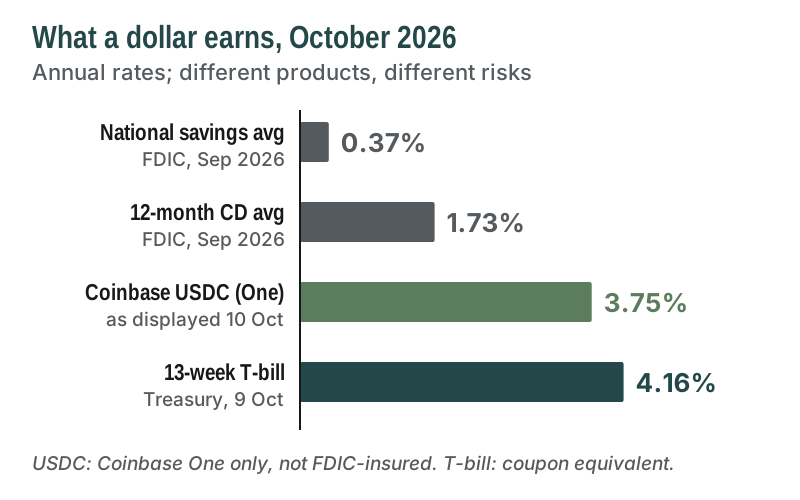
The rates are not the whole comparison. A bank savings account at an FDIC-insured bank is protected up to the insurance limit and needs no membership. A Treasury bill is a direct obligation of the US government. USDC rewards depend on a private stablecoin, a private custodian, a subscription and a programme that can change. If the higher rate is the attraction, it is worth asking whether a Treasury bill or a Treasury money market fund does the job with fewer moving parts.
If you already keep USDC on Coinbase and pay for Coinbase One, the rewards are a reasonable perk and opting in costs nothing. If you are considering moving savings there for the rate, run the break-even maths first: below roughly $1,597 on monthly billing, or $1,333 on the annual plan, the membership fee outweighs the reward. If you still want to proceed, Coinbase's USDC page shows the current terms for your region. Plainyield may be paid a commission on sign-ups; the analysis above stands either way.
Taxes on rewards
For US taxpayers, the IRS tells you to answer "Yes" to the digital-asset question on Form 1040 if you received digital assets as "a reward or award", and it requires records of the fair market value, in dollars, of digital assets received as income. Coinbase's own help page says US customers "are generally required to report their earnings from USDC Rewards." Because USDC is designed to track the dollar, the value received is usually close to the number of tokens paid.
On paperwork, Coinbase's USDC help page says US customers who receive more than $600 in USDC rewards get a Form 1099-MISC, the threshold that applied to 2025 payments. The IRS raised the 1099-MISC reporting threshold to $2,000 for payments from 2026, and Coinbase's tax-information page now shows $2,000. Either way, the income is reportable even if no form arrives. If you take rewards in bitcoin instead, a later sale of that bitcoin is a separate taxable disposition. Our crypto lending and taxes guide covers the wider picture; this is not tax advice.
Edge cases
- USDC in a self-custody wallet earns nothing from this programme; rewards apply to USDC held in your Coinbase account.
- Coinbase's developer platform runs a separate USDC rewards programme for apps and developers with its own rate and rules; it is not the consumer app rate.
- Outside the US, eligibility and membership rules differ by country, and some regions do not require Coinbase One.
- Restricted accounts still accrue rewards, Coinbase says, but you may not be able to access them during the restriction.
- Promotional boosts for some members are temporary; budget on the standard rate.
Risks and what can go wrong
The realistic downside is not a dramatic collapse but a slow erosion: the rate is cut, the membership price rises, a law restricts rewards, or USDC briefly trades below a dollar when you need to sell. The tail risk is custodial: if Coinbase ever failed, the legal treatment of customer assets has not been tested in court. Crypto and stablecoins carry risks that insured bank deposits do not, and no rate is guaranteed. None of this is financial advice. For the broader case on yields, read how crypto interest accounts work.
Common questions
What is the Coinbase USDC rewards rate in 2026?
Do you need Coinbase One to earn USDC rewards?
Are Coinbase USDC rewards safe and FDIC-insured?
How are USDC rewards taxed?
Will the GENIUS Act end USDC rewards?
New to this? Start with how earning interest on crypto works, or read every guide. None of this is financial advice.