Plain-terms guide
Crypto-Backed Loans: Borrowing Against Bitcoin and the Liquidation Risk
A crypto-backed loan lets you borrow dollars or a stablecoin by pledging coins you already own, usually bitcoin, without a credit check. The catch sits in one number, the loan-to-value ratio: if bitcoin falls far enough, the lender sells your collateral automatically, often with a penalty, and you can lose the coins you were trying to keep. With a typical 50% starting ratio, a fall of roughly 38% to 42% is enough at the lenders we checked on 10 October 2026.
Borrowing against crypto can make sense for someone with a short, specific need for cash, a repayment plan that does not depend on the price going up, and spare coins or cash to top up the loan in a crash. It is a poor fit for anyone borrowing to buy more crypto, anyone who would struggle to repay within months, and anyone who has not yet worked out their liquidation price. This guide shows the maths, compares how Coinbase, Nexo, Ledn and DeFi protocols handle it, and covers taxes and the 2022 lessons. Treat it as general education; it is not advice about your own finances.
Short answer
Crypto-backed lending is over-collateralised borrowing: you hand over more value than you receive, and the gap is the lender's cushion against a price drop. The rate is usually the smaller cost. The larger one is the risk of a forced sale at the bottom of a market, at a moment you did not choose, which turns a temporary price fall into a permanent loss of coins and can create a tax bill as well.
Three questions decide whether a particular loan is tolerable. How far can the collateral fall before liquidation, including interest and fees that keep adding to the balance? Who holds the collateral while the loan is open, and can they lend it out? And where would the money to repay come from if the price never recovers? If you cannot answer all three, do not borrow yet.
How a crypto-backed loan works
The mechanics are close to a pawn loan with a live price feed. You deposit collateral, the lender pays out a fraction of its value, and interest accrues on what you owe. The ratio between the debt and the collateral's current market value is the loan-to-value ratio, or LTV. Borrow $10,000 against $20,000 of bitcoin and your LTV starts at 50%. Two things push it up afterwards: a lower bitcoin price shrinks the denominator, and accrued interest and fees grow the numerator.
Lenders set two or three thresholds above the starting ratio. An alert or margin-call level warns you to add collateral or repay part of the debt. A liquidation level triggers an automatic sale of enough collateral to bring the loan back into line or close it, usually with a fee on top. Most lenders do not set a fixed repayment date for variable-rate loans, which sounds generous but means the risk never expires while the loan is open.
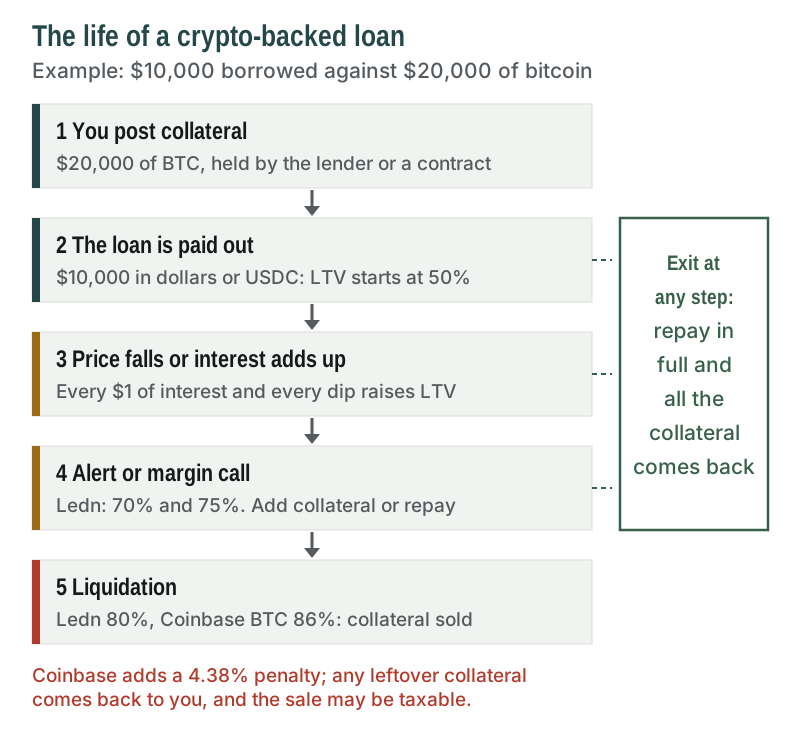
Repaying in full at any point ends the risk and returns the collateral. Topping up with more coins lowers the ratio but puts more of your holdings at the same lender. Partial repayment in cash is the cleaner fix, if you have the cash.
LTV and liquidation: worked tables
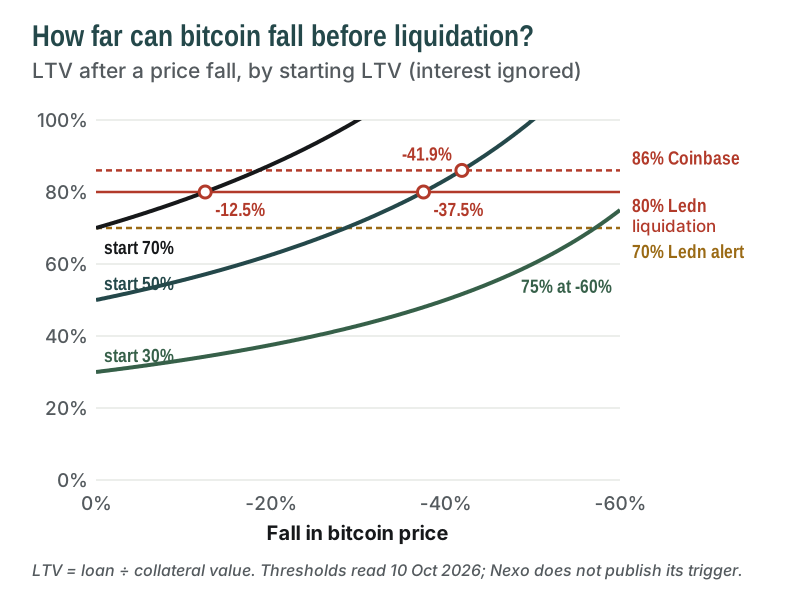
The useful number is not the liquidation LTV itself but the price fall that gets you there. Ignoring interest, the fall that triggers liquidation is one minus your starting LTV divided by the liquidation LTV. The table applies that to three starting ratios and the thresholds Ledn and Coinbase publish for bitcoin. Nexo publishes a 50% maximum starting LTV for bitcoin but not the level at which it automatically repays from collateral, so it cannot be calculated here.
| Starting LTV | Ledn first alert (70%) | Ledn liquidation (80%) | Coinbase BTC liquidation (86%) |
|---|---|---|---|
| 30% | 57.1% fall | 62.5% fall | 65.1% fall |
| 50% | 28.6% fall | 37.5% fall | 41.9% fall |
| 70% | Already there | 12.5% fall | 18.6% fall |
Now run it the other way, from the price moves bitcoin has a history of making. A 20% drop takes a 50% loan to 62.5% LTV, which is uncomfortable but survivable at both lenders. A 40% drop takes it to 83.3%, past Ledn's liquidation line and deep into what Coinbase's help pages call the danger zone, which starts at 90% of the threshold (77.4% for an 86% market). A 60% drop puts the debt above the value of the collateral, so the loan would have been liquidated long before. Starting at 30% survives all three, ending at 75% after a 60% fall. Starting at 70% is liquidated at both lenders by a 20% fall.
Interest and fees move the line closer
Those figures flatter the borrower, because the debt grows while you wait. Coinbase says its LTV includes accrued, unpaid interest, and it adds a one-time processing fee to the principal: 2% on the first $250,000 and 1% above that, according to its help centre on 10 October 2026. A loan may also carry a separate platform fee, shown before you borrow. Take $10,000 against $20,000 of bitcoin: the processing fee lifts the opening debt to $10,200, or 51% LTV, before any interest. If the variable rate stayed at the 5.1% Coinbase's borrow page headlined that day, which it need not, a year of interest would take the balance to roughly $10,720, about 53.6% LTV, and the fall needed to reach 86% would shrink from 41.9% to about 37.7%. Check whether your lender counts accrued interest in LTV; it changes how quickly a quiet loan drifts toward the line.
CeFi vs DeFi loans
The same LTV maths applies everywhere, but who holds the collateral differs, and that decides what happens if something other than the price goes wrong. Our broader CeFi vs DeFi lending guide covers the trade-off for depositors; for borrowers it plays out like this.
Custodial (CeFi) lenders such as Nexo and Ledn take your coins into their custody and lend you dollars or stablecoins from their own balance sheet or funding partners. You are relying on the company to hold the collateral, to calculate LTV fairly and to return the coins when you repay. Ledn makes a specific claim here: it says collateral is held in custody for the life of the loan, ring-fenced from a funding partner's assets or held in bankruptcy-remote financing vehicles, and that neither Ledn nor its funding partner has the right to lend it out for yield. We could not load Nexo's terms page, so its rules on what it may do with pledged coins are not quoted here; its US earn page says its business is centred on interest-rate spreads on its collateralised Credit Lines. Read the custody and re-use clauses of any lender before posting coins, and see not your keys, not your coins for why it matters.
Coinbase's loans are a hybrid. Coinbase provides the interface, but the loan runs on Morpho, an on-chain lending protocol on the Base network. For a bitcoin loan, your BTC is withdrawn from your account, converted to Coinbase Wrapped BTC (cbBTC) and locked in a Morpho smart contract; Coinbase's help pages list protocol-level security vulnerabilities, protocol liquidity problems and smart-wallet issues among the risks. Coinbase also says it cannot prevent your collateral from being liquidated, so monitoring is on you. Its optional loan protection can top up collateral automatically from your balance, but Coinbase states it is not a guarantee against liquidation.
Fully self-directed DeFi borrowing, on protocols such as Aave, removes the company entirely. Aave's documentation says a position becomes eligible for liquidation when its health factor falls below 1.0, and outside liquidators repay part of the debt in exchange for collateral plus a bonus. Nobody calls you first. You hold your own keys, but you also carry the smart contract risk, oracle risk and gas costs, and a mistake cannot be reversed by a support desk.
Rates and fees (dated)
Rates in this market are headline-driven. Each lender advertises its best case, and the conditions behind it vary: loan size at Ledn, loyalty tier and LTV at Nexo, and live supply and demand in the Morpho market at Coinbase. The table compares what each one's own pages said, with the date.
| Coinbase (via Morpho) | Nexo Credit Line | Ledn | |
|---|---|---|---|
| Model | On-chain: BTC wrapped to cbBTC in a Morpho contract | Custodial credit line | Custodial; says collateral is not lent out |
| Headline rate | Variable, "from 5.1%"; fixed-rate option | From 0.9% a year (US page); from 1.9% (global page) | 11.49% APR under $250,000; 9.25% to 9.99% for the largest loans |
| Starting LTV | Shown in the app | Up to 50% for BTC and ETH | 50% |
| Liquidation | 86% LTV for BTC; 4.38% penalty | Automatic partial repayment; threshold not published | Alerts 70% and 75%; liquidation at 80% |
| Fees named | Processing fee 2% (1% above $250,000); possible platform fee | Not itemised; the US borrow page says interest, fees and spreads may apply and links a fee schedule | 2% administration fee where applicable (Ledn says not for US or Canada clients); 0.50% trade spread if collateral is liquidated |
| Term | Variable: none; fixed: set maturity | No fixed repayment dates | 12-month standard term, no required monthly payments |
| US availability | US excluding New York; limited UK and Canada | Relaunched for US clients 16 Feb 2026 | Varies by location |
Read the table for structure rather than for the cheapest number. Coinbase's floating rate can rise with demand in its lending market, and its fixed-rate loans must be repaid in full by maturity or they become eligible for liquidation even when the LTV is healthy. Nexo's lowest rates require its top loyalty tier, which means holding its own token. Ledn's loans are pricier per year but come with a fixed standard term and a published liquidation level, and the minimum is $500. Ledn's own tier table and calculator disagreed on the top tier's rate when we read it, 9.25% against 9.99%, so confirm the figure on your own quote.
Tax treatment of borrowing vs selling
The main reason people borrow against bitcoin rather than sell it is tax, so this part deserves precision. For US federal tax, digital assets count as property, and Form 1040 asks every filer whether they sold, exchanged or otherwise disposed of any during the year. Its digital-assets page, as we read it on 10 October 2026, does not address crypto-backed loans specifically. Coinbase says it will not treat your borrow transaction as a taxable event, which describes how Coinbase reports it, not a ruling from the IRS.
Liquidation is the clearer case. When a lender sells your collateral to repay the debt, your coins have been sold, and a sale is the kind of disposal the IRS asks about. Your profit or loss on that sale is the sale price minus what you originally paid, and holding the coins for a year or less makes it short-term. A borrower who took a loan to avoid a taxable sale can end up with a forced sale anyway, at a low price and with a penalty. Wrapping bitcoin into cbBTC and moving it into a contract is another step on which the IRS has published nothing specific; Coinbase's own help text tells users to keep detailed records and consult a tax professional. Our crypto lending and taxes guide covers the rest, and rules outside the US differ.
What happened in 2022
Over-collateralisation protects the lender against the borrower. It does nothing to protect the borrower against the lender. If you post $20,000 of bitcoin to borrow $10,000 from a custodial platform, the extra $10,000 of coins is value the platform owes back to you, and if the platform fails you become a creditor for it.
That is the lesson of the 2022 lending collapse, covered in our timeline of the failures. Celsius customers waited until the bankruptcy plan became effective in January 2024 for a first payout, and after a second round, noticed to the court in November 2024, eligible creditors stood at roughly 60.4% of their claim values. BlockFi clients fared better on paper: the estate told them in July 2024 to expect the full allowed amount of eligible claims, but those claims were fixed in dollars at the filing date, and the money arrived more than a year after the bankruptcy filing. For anyone with coins on a failed platform, a dollar-denominated claim means missing any recovery in the price while the case runs.
The practical rules that follow are simple. Prefer lenders that state plainly whether collateral can be re-used, keep the excess collateral at any custodial lender as small as the loan allows, and weigh a lower rate against a weaker custody answer. Our checklist in is crypto lending safe? applies to lenders on both sides of the loan.
Edge cases
A crash with an outage. Lenders liquidate on their own systems' prices, and fast markets are when apps lag and networks congest. Coinbase notes that during market-wide drops its loan protection is applied to the loans closest to liquidation first. Do not plan on adding collateral in the minute it is needed.
Auto top-ups need funding. Ledn's Auto Top-Up rebalances a loan at 70% LTV back to 68% using bitcoin from your Ledn Transaction Account, which only works if that account holds enough. Coinbase's protection must be re-enabled after each use and expires after a year.
Stablecoin proceeds. Coinbase pays out USDC and its terms bar using loan proceeds for trading on Coinbase. If the stablecoin you receive ever lost its peg, your debt would still be counted in it; our stablecoin depeg guide explains that risk.
Moving house. Coinbase says moving to an ineligible location may affect access to existing loans. New York residents are excluded from its loans, and Ledn says availability and minimums vary by country, state or province.
Risks and what can go wrong
- Forced sale. A fast price fall can liquidate your collateral at the bottom, permanently converting coins to debt repayment, with a penalty on top.
- Rising debt. Interest and fees keep lifting the LTV even when the price does not move, and variable rates can rise.
- Custodial failure. A lender holding your collateral can freeze, fail or re-use it; you may recover less than the coins were worth, years later.
- Contract and protocol risk. On-chain loans depend on code, price oracles and liquidity that can fail, with no one to reverse a liquidation.
- Tax on a sale you did not choose. A liquidation is a sale of your coins and can create a capital gain.
- Spending risk. Borrowing to buy more crypto doubles your exposure to the same fall that triggers liquidation.
Prices can fall fast enough to take every coin you pledge, so a loan of this kind can cost you the whole collateral. This guide is not financial advice, and for many readers the right loan size is zero.
Before you borrow: a checklist
If you still want a loan, write down your liquidation price before you sign, using the lender's own threshold and your real starting LTV including fees. Start well below the maximum ratio: the table above shows that a 30% start survives falls that liquidate a 50% loan. Keep cash or spare coins outside the lender, ready to repay, and set price alerts of your own rather than relying on the lender's. Read the custody clause, check whether accrued interest counts toward LTV, and confirm the loan is available where you live.
For an on-chain loan inside a large US exchange, Coinbase's borrow page lists its current rate and terms; for a custodial credit line, Nexo's borrow page shows its LTV limits for your region. Either company may pay us if you sign up through the links below; that payment had no influence on the risks set out above: see Coinbase's loan terms or see Nexo's Credit Line terms.
Crypto-backed loans: common questions
What are crypto-backed loans?
What is the Coinbase loan interest rate?
Should I use Ledn or Nexo for my bitcoin loan?
Is borrowing against crypto a taxable event?
What happens to my loan if bitcoin crashes?
New to this? Start with how earning interest on crypto works, or read every guide. None of this is financial advice.