Plain-terms guide
Nexo Review 2026: Yield, Loans and the Risks You Take On
Nexo is a custodial crypto lender: you deposit coins, Nexo holds them and pays a variable yield, and it also lends dollars and stablecoins against crypto collateral. Our short verdict is that it is a real, long-running company with a regulatory record you should read before trusting it with savings. It settled with the SEC and US states for $45 million in 2023, left the US, and reopened to US clients on 16 February 2026 through Bakkt. Its top advertised rates, up to 14% on its US page as displayed on 10 October 2026, come with conditions, and any balance you leave there is an unsecured exposure to a private company.
Nexo may suit someone who understands custodial risk, wants a crypto-backed credit line or yield on a small slice of holdings, and accepts that the whole deposit could be lost. It is a poor fit for emergency savings, for anyone who would treat it like a bank account, and for anyone who cannot say where the yield comes from. This review explains the product, the rates and their conditions, the regulatory history, and the risks. It is education, not financial advice.
Short verdict
Nexo is not a scam and not a safe harbour. It survived the 2022 lending collapse that destroyed Celsius, Voyager and BlockFi, it publishes security certifications, and it now runs its US business with a publicly listed partner. It is also a custodial lender whose yields depend on lending and trading activity you cannot inspect, whose best rates require holding its own token, and whose US history includes a regulator-imposed shutdown of its earlier yield product. If you use it, size the deposit as a loss you could absorb, keep long-term holdings in self-custody, and read the terms for your country before opting in.
What Nexo is and how it earns yield
Nexo describes itself as operating since 2018 and serving more than 10 million clients. On its US security page, read on 10 October 2026, it reported more than $7 billion of client assets, a loan book above $1.7 billion and over $1.5 billion of interest paid since 2019, as global figures at Q2 2026. Those are the company's own numbers, not audited disclosures we could check.
The yield has to come from somewhere, and Nexo's US earn page gives its own answer: its business model is "centered around interest rate spreads on its collateralized Credit Lines, transaction fees from its exchange and payment services, and market-neutral treasury strategies." In plain terms, deposited coins help fund loans to other clients and Nexo's own trading operations, and depositors are paid out of the margin. That is the standard custodial-lending model, and it is the same broad structure the failed lenders used: the rate you see depends on borrowers repaying and on strategies working as described. Our guide to how crypto interest accounts work explains the model in general.
Nexo's full terms page did not render for us, so we cannot quote its clause on how client assets may be used or re-pledged. Read that section of the terms for your region before depositing; if you cannot find or understand it, treat that as an answer.
Rates and loyalty tiers (dated)
Nexo advertises rates as "up to" figures, and the "up to" carries most of the weight. The table shows what two of its pages displayed this week. The US page lists top rates per asset; the global page lists flexible rates. They are different products in different regions on different days, which is why they disagree.
| Asset | US page, "up to" | Global page, flexible "up to" |
|---|---|---|
| Headline | 14% on 20 assets | 13% on 30+ assets |
| USDC | 10.5% | 8.5% |
| USDT | 10.5% | 9.5% |
| Bitcoin (BTC) | 6% | 4.7% |
| Ether (ETH) | 7% | 5.25% |
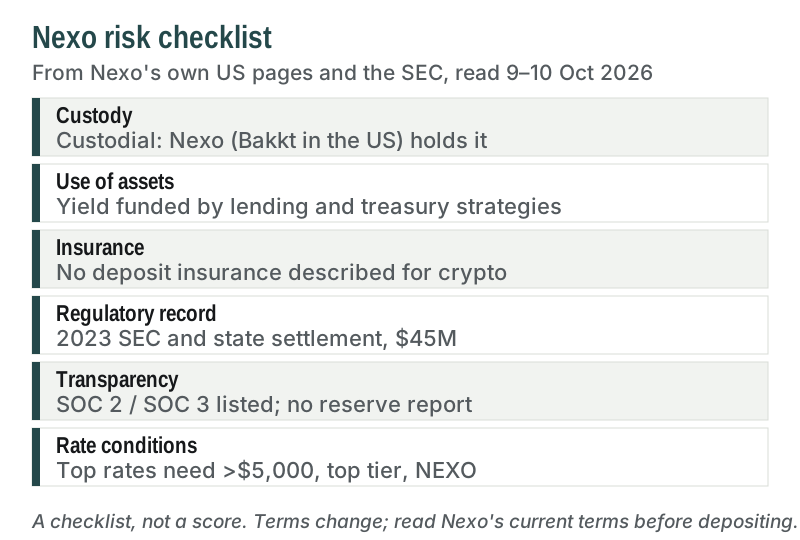
Now the conditions. Nexo's US FAQ says that to start accruing interest you must opt in and "maintain an account balance above $5,000 worth of digital assets." To reach the highest rates you also need a Signature Wealth Tier in its Wealth Club loyalty programme and must opt to receive interest in NEXO tokens, which adds "2% additional interest." On the global page, the top Platinum tier requires NEXO tokens worth at least a tenth of your portfolio. In other words, the headline rate assumes you hold a meaningful slice of Nexo's own token and accept payment in it, so part of the advertised yield is exposure to a single company's token price.
Read the gap between USDC at 10.5% and US Treasury bills, which yielded about 4.2% on a 13-week basis on 9 October 2026, as a measure of risk rather than generosity. A rate well above what governments pay has to be funded by lending to riskier borrowers or by trading. We make the general case in why high crypto yields are a red flag.
Regulatory history
Nexo's US story is the most important part of this review, because it shows what can happen to a yield product after you deposit.
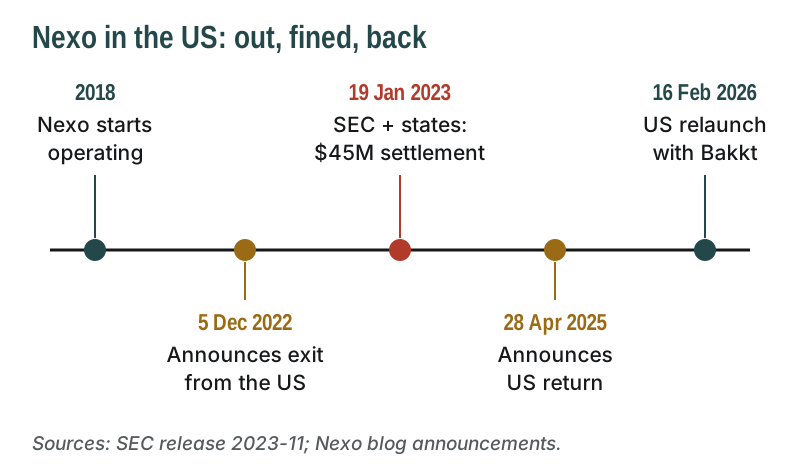
On 5 December 2022 Nexo announced it was "phasing out its products and services in the United States". On 19 January 2023 the SEC charged Nexo Capital with failing to register the offer and sale of that product; Nexo agreed to pay a $22.5 million SEC penalty and another $22.5 million to state regulators, $45 million in total, and to stop the unregistered offering to US investors.
Nexo announced on 28 April 2025 that US clients would regain access to its products, without a launch date. US clients regained access on 16 February 2026 to Flexible and Fixed-term Yield, an exchange, crypto-backed Credit Lines and the loyalty programme, with Bakkt supplying the trading infrastructure. Nexo's US pages say assets are "held with Bakkt, a publicly listed U.S.-based digital asset platform." Two lessons follow. Products can be withdrawn by regulators with little warning to depositors, and the version available in your country can differ from what you read about elsewhere.
Custody, proof of reserves and insurance claims examined
Nexo is custodial. Once coins land in your account, Nexo (and, for US clients, Bakkt) controls the keys, and you hold a claim on the company. That is the defining risk of any crypto lender, covered in our guide to not your keys, not your coins.
On transparency, Nexo's security page lists SOC 2 Type 2 reports "for three years in a row" and a public SOC 3 report. Those audits test how a company handles data and security controls; they do not show whether customer assets are fully backed. The security page we read did not show a proof-of-reserves or reserve attestation, and it names no insurance arrangement for client crypto. Nothing on Nexo's US pages describes FDIC or SIPC cover for crypto balances. Treat any balance as uninsured.
Loans and liquidation
Nexo's other main product is the Credit Line: you post crypto as collateral and borrow against it without a credit check. Its US borrow page, read on 10 October 2026, showed rates that "start at 0.9% per year", amounts from $50 to $2 million, and maximum loan-to-value ratios of 50% for bitcoin and ether, 15% for the NEXO token and 90% for USDC and USDT. The lowest rate applies to the best loyalty tier, so most borrowers pay more.
If the collateral falls, the loan-to-value ratio rises, and Nexo's page says that "when it reaches a certain threshold, Nexo automatically repays part of your Credit Line using a portion of your collateral." The page does not publish that threshold. Before borrowing, find the number for your account in the app and work out how far bitcoin would have to fall to reach it; at a 50% starting ratio, a fall of about 38% takes a loan to 80%. Our guide to crypto lending and taxes covers what a forced sale of collateral can mean for your tax bill.
Availability by country
Nexo serves clients in many countries, but products, rates and terms vary, and its own pages say so: "Rates, product availability, features, and applicable terms may vary based on jurisdiction, eligibility, loyalty tier, and other factors." In the US, the relaunched platform runs with Bakkt; Nexo did not publish a list of eligible states with the relaunch announcement we read. In Australia, its security page lists a registration with AUSTRAC as a digital currency exchange provider. Check the app for your own location before assuming any rate in this review applies to you.
Nexo vs the failed lenders of 2022
Comparisons with Celsius and BlockFi are fair, in both directions. The similarities are structural: all three took customer crypto into custody, paid yields above bank rates by lending it out, offered crypto-backed loans, and promoted a house token. The difference is the outcome. Celsius froze withdrawals in 2022 and went bankrupt; after its plan took effect on 31 January 2024 and a second distribution later that year, eligible creditors had recovered roughly 60% of their claims. BlockFi's estate told clients in July 2024 that eligible claims would be paid in full at their allowed dollar value, fixed at the bankruptcy date, after more than a year in proceedings. Nexo kept operating.
Surviving one crisis is evidence of risk management, not a guarantee against the next one. Our 2022 crypto lending collapse timeline shows how quickly the failures unfolded, and is crypto lending safe? sets out the questions to ask any lender, Nexo included.
Risks and what can go wrong
- Counterparty failure. If Nexo or a custody partner fails, you are a creditor in a legal process, and recovery can take years and fall short.
- Withdrawal freezes. Custodial platforms can pause withdrawals during market stress; the 2022 freezes came without warning.
- Rate cuts and tier changes. Rates are variable, and Nexo's pages say rates and terms are subject to change at any time.
- Token exposure. Top rates depend on holding NEXO and taking payouts in it, adding the price risk of one company's token.
- Regulatory change. A product can be withdrawn in your country, as Nexo's US yield product was in 2022 and 2023.
- Market falls. Interest on a coin does not protect against its price falling, and collateral can be sold automatically if you borrow.
Crypto is volatile, a yield product adds platform risk on top, and you can lose the whole deposit. None of this is financial advice.
If you decide to use Nexo
If you go ahead, keep the deposit modest next to your savings, start with the asset you understand best, read the current terms and rates for your country in the app, and note the automatic-repayment threshold before taking any credit line. Self-custody that earns nothing remains a legitimate choice, and for many people it is the better one; our safest ways to earn interest on crypto guide compares the options. If you still want an account, Nexo's sign-up page is where to read its current terms. Plainyield may be paid a commission when a reader opens an account; that has not changed anything written above.
Common questions
Is Nexo safe?
What is Nexo?
Is Nexo available in the US?
What interest rates does Nexo pay?
Is Nexo better than Celsius or BlockFi were?
New to this? Start with how earning interest on crypto works, or read every guide. None of this is financial advice.